
March 30, 2026
Student researchers take the national stage
This April, a group of six Edmonds College student researchers will embark on a transformative journey to Richmond, Virginia, for the 2026 National Conference on Undergraduate Research (NCUR). Led by faculty mentors Mary Whitfield (Chemistry) and Gwen Shlichta (Biology), these students will present their original work at the largest undergraduate research symposium in the country, held from April 13-15 at the Greater Richmond Convention Center.
Monitoring the Hive: One Team’s Project
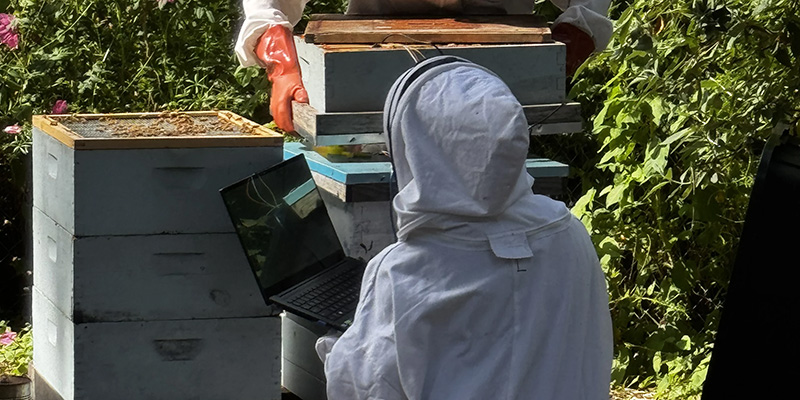
Among the presenters is Nayara "Naya" Nasution, an engineering student whose research combines environmental science with high-tech solutions. Naya and fellow student, Sahana Prabhu, built their project, a remote beehive monitor, which tracks three critical health indicators for bee colonies: hive weight, buzz frequency, and temperature.
What began as a mandatory class project has evolved into a sophisticated personal research endeavor. While Naya and Sahana’s initial prototype required them to be in the field with a computer to analyze raw numbers, they have since upgraded the system to use a microcontroller that sends data via Wi-Fi, enabling remote monitoring.
“The data we get through the sensor allows us to see the intensity of their buzz to make sure if the bees are okay,” Naya said.
Their project highlights the interdisciplinary nature of research at Edmonds, as they received guidance from both the chemistry and physics faculty and used Monroe Hall’s specialized machinery to construct the monitor.
The Power of Community College Research
The delegation represents a diverse range of disciplines, including engineering, biology, chemistry, and political science. Projects range from investigating dissolved oxygen in local watersheds to studies involving the cabbage white butterfly.
Providing these opportunities at the community college level is intentional. Whitfield and Shlichta emphasize that such experiences are foundational, helping students build a "STEM identity."
“Our initial research shows that these experiences are transformative for a student,” said Professor Whitfield. “When a visiting expert validates a student's work, it shifts their perspective from 'I don’t see myself doing this' to 'I am actually doing this.' Through dedicated mentoring, our students produce high-quality research that earns the professional recognition they deserve, whether here on campus or at national conferences."
In addition to professional validation, the NCUR experience offers career-readiness opportunities through sessions on resume building, grad school applications, and essential career skills. They will also gain valuable networking opportunities to forge connections with a national community of scholars, mentors, and fellow students.
Innovation Funded by Excellence
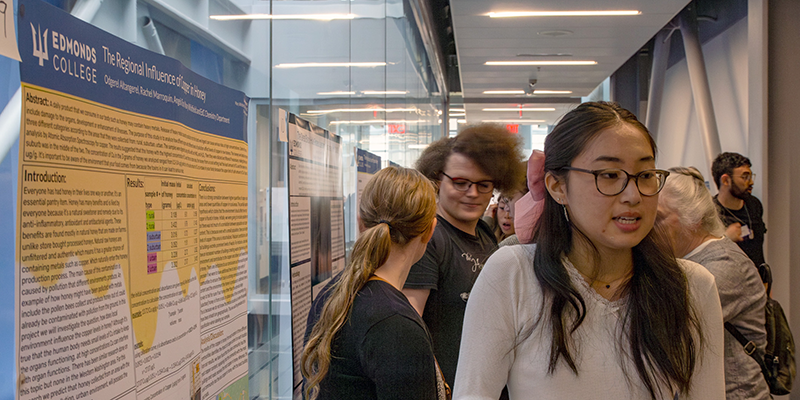
Undergraduate research opportunities are not universally available at all community colleges in Washington, so Edmonds is ahead of the curve. The school has hosted an annual Undergraduate Research Symposium that allows students to display and discuss their projects with peers, curious community members, and visiting experts from academia. It is a popular event that grows each year on campus.
As students become more engaged in undergraduate research opportunities, faculty are also eager to incorporate it into their curricula. Faculty in communications, sociology, and political science are now creating opportunities for their students to partake in undergraduate research, joining their counterparts in the STEM fields.
The upcoming NCUR trip is the next step in expanding undergraduate research opportunities at Edmonds. A $500,000 National Science Foundation (NSF) grant awarded to Whitfield and Shlichta for the "Innovation in Two-Year College in STEM Education" program is the primary funder of the trip. This grant helps foster inclusivity in STEM by providing students with external validation experiences. Additionally, Edmonds’ student government provided funding to ensure all six students could participate.
As Naya and her peers prepare to fly to Virginia, they carry more than just posters and data; they carry proof that students at traditional two-year colleges are capable of high-level, national-caliber research. When they stand by their presentations in Richmond, they aren’t just students—they are the next generation of scientists, engineers, and thinkers.